A first oncology fitting needs to cover six things in about ninety minutes: why she is here and what her treatment timeline looks like, the condition of her scalp today, four cap measurements written down in a record you can find again, a color and density match taken against hair she still has, a cap construction chosen for a scalp that is about to become tender, and a home care walkthrough she can remember when she is tired. Then she leaves with paperwork: an order record and the documents she will need if she wants to submit a claim.
The order matters. Measurements before color, because a cap that does not fit will never look right no matter how good the match is. Color before construction, because what you have available in her shade will narrow the construction options in front of her. Paperwork last, when the emotional part of the appointment is over and she can actually take in what you are telling her.
What follows is the sequence, with the timings that tend to hold up in a real studio, and the specific things worth writing down at each stage.
Booking the appointment before treatment starts, and why the timing matters
The best appointment happens after the oncologist has laid out the regimen and before the first infusion. Anthracycline and taxane based regimens typically bring visible shedding somewhere in the second or third week after the first cycle. That gives a narrow window where she still has her own hair to match against, still has energy, and is not yet grieving the loss.
Ordering time is the practical constraint. A stock synthetic in a standard cap size can be on her head that day. A special order in a specific color or cap size runs one to four weeks depending on the manufacturer, and a custom cranial prosthesis built to her measurements runs six to twelve. If she is booking with three weeks until shedding starts, custom is off the table for this round, and she needs to hear that early rather than at checkout.
The pre appointment call
Fifteen minutes on the phone before she arrives saves twenty in the chair. Say plainly that coming in before the first treatment lets you match color from her own hair rather than a photograph. Ask her to bring a photo of herself with her usual hair, ideally in daylight. Ask whether she has a prescription yet, and if not, tell her what to ask for, because that request is far easier to make at an appointment she already has scheduled than to arrange later. Tell her she is welcome to bring someone, and tell her the appointment takes about ninety minutes so she does not schedule an infusion right after it.
Keep reading: How do I write a cranial prosthesis insurance letter that a carrier will actually accept?
Intake questions that shape the recommendation: diagnosis, treatment plan, expected shedding timeline
You are not practicing medicine. You are gathering the facts that change what you should put on her head. Five questions cover most of it.
- What is the diagnosis, and who is the prescribing physician? You need the physician name and practice for the prescription and for any letter that follows.
- What is the treatment plan and how long does it run? Four cycles over twelve weeks and a year of maintenance are different wear lives. A twelve week course means she may be in this piece for six to nine months counting regrowth.
- Is radiation involved, and to what field? Radiation to the head changes scalp sensitivity and can change regrowth patterns in the treated field.
- Is she using scalp cooling? Cold capping can mean partial retention, which points toward a topper or a partial rather than a full cap.
- Does she work, and in what setting? A woman teaching third grade all day has different demands than one working from home two days a week.
Write the answers into the client record, not on a sticky note. In eight months when she calls about regrowth and a transition piece, that record is the whole conversation.
Taking and recording the four cap measurements accurately
Four measurements carry the fit. Take them with a soft fabric tape, with her hair flat or with a wig cap on, sitting upright with her chin level.
| Measurement | How to take it | Typical range |
|---|---|---|
| Circumference | Around the head, at the front hairline, above the ears, around the nape bone | 20.5 to 23 inches |
| Front to nape | Center of front hairline straight back over the crown to the nape hairline | 13 to 15 inches |
| Ear to ear over the top | From the top of one ear, over the crown, to the top of the other | 11 to 13 inches |
| Temple to temple around the back | Around the back of the head from one temple to the other | 13 to 15.5 inches |
Two habits that prevent remakes. Take each measurement twice and record the second one. And note the tension you used, because a tape pulled snug and a tape laid gently differ by roughly a quarter inch, which is the difference between a cap that grips and a cap that slides.
Record the date alongside the numbers. Scalp measurements taken with a full head of hair and measurements taken four months later on a bare scalp are not the same numbers, often by a half inch on circumference. If she comes back for a second piece, you remeasure, and you want to know which set is which.
Keep reading: Should I stock human hair or high heat friendly synthetic wigs for my chemotherapy clients?
Matching existing hair: color, density, texture, and part placement
Match at a window in daylight, or under a color corrected lamp. Overhead fluorescent will make you order a piece that looks green in her car.
Take the match from the mid lengths, not the ends and not the roots. Ends are sun lifted, roots are usually darker than what she thinks of as her color. Then ask the question that matters more than the swatch: does she want to look exactly like she does now, or is this the moment she has been waiting for to go two shades lighter? A meaningful number of clients want the second thing and feel they need permission to say so.
On density, most women overestimate their own. Stock wigs frequently ship denser than natural hair on a woman in her fifties. If she brought a photo, hold the sample against it. Note in the record whether the piece will need thinning at delivery, because that is chair time you should be booking now rather than discovering later.
Part placement is the tell that separates a piece that reads as hair from one that does not. Note her natural part side and roughly how far off center it sits. A monofilament top lets you move the part; a standard machine wefted cap does not.
Cap construction choices for a sensitive scalp
Chemotherapy makes the scalp tender and often dry, and some women get folliculitis during shedding. That pushes the construction decision in a specific direction.
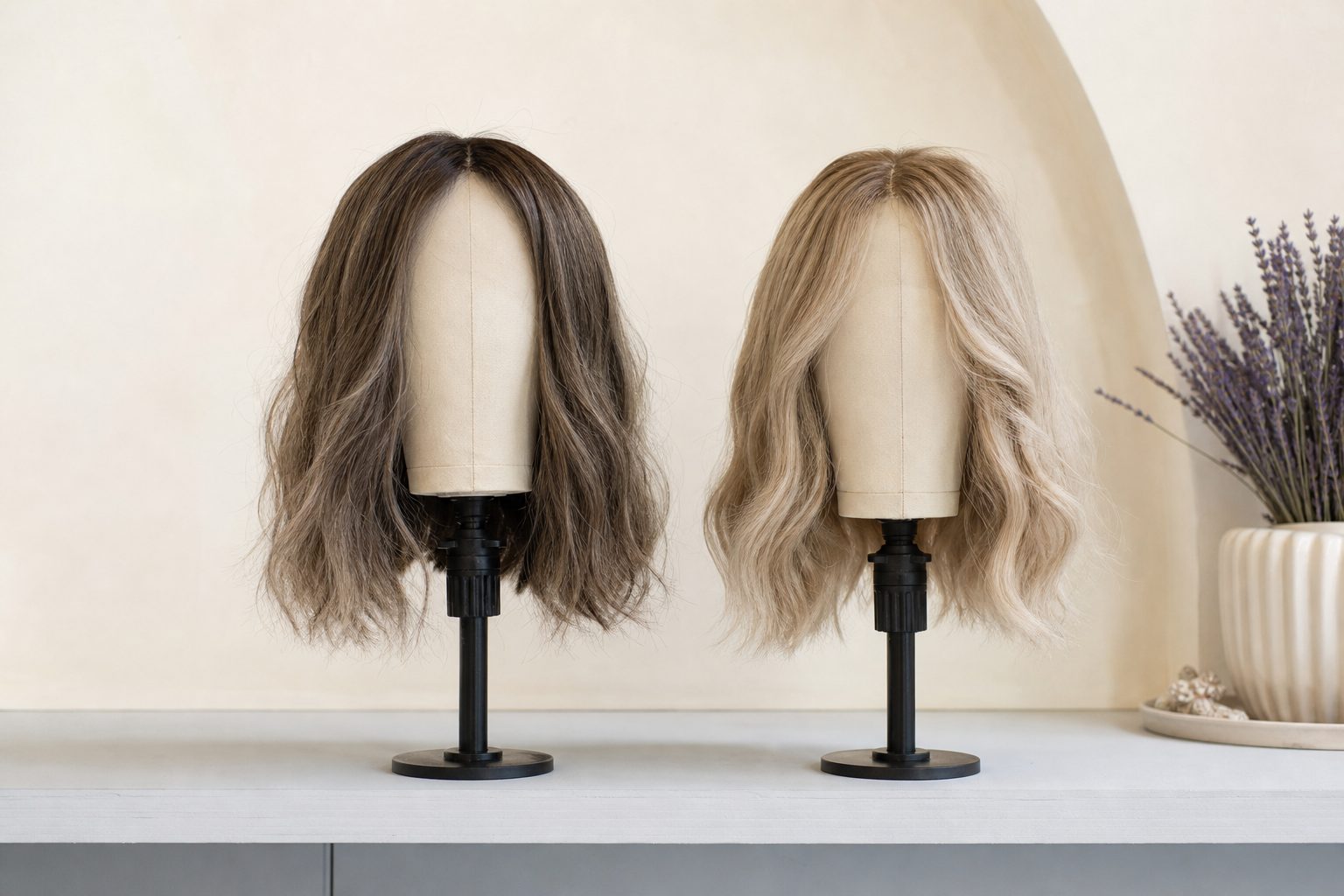
- Wefted open cap. Most breathable, lightest, least expensive. Good for hot climates and for women who tolerate a bit of visible cap at the part. The elastic band at the nape is the usual irritation point.
- Monofilament top. Individually hand tied strands at the crown on a fine mesh, so the scalp shows through and the part can move. Softer against a bare scalp than machine wefting.
- Full hand tied. Every strand tied by hand throughout. Lightest against the head and the most forgiving on a tender scalp, and the most expensive by a wide margin.
- Lace front. A hairline detail, not a comfort feature. Worth it for women who wear their hair back.
Whatever you pick, discuss the interior. Many caps come with a polyurethane or silicone strip at the temples and nape. On a bare scalp with no hair to buffer, some women find those strips hot and itchy. A soft bamboo or cotton liner cap underneath solves it for most, and it costs a fraction of a remake.
See how StrandRestore handles this for wig and hair loss studios
Walking the client through wear, wash, and storage before she leaves
Do this with the piece on her head, in the mirror, and let her do each step once herself. Watching is not learning.
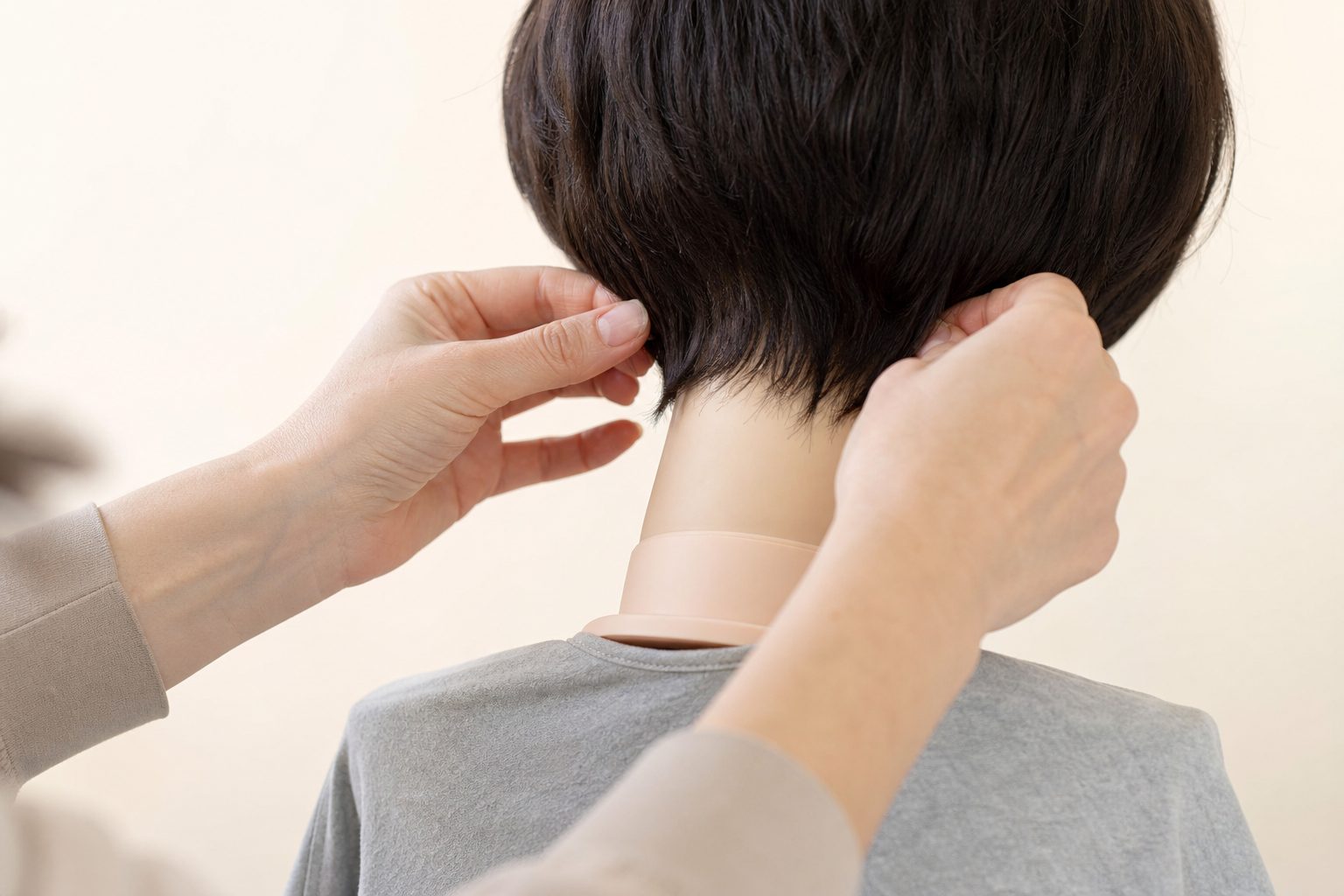
- Putting it on. Front hairline first, roughly a finger width above her natural hairline, then pull back and settle the nape. Adjust the tabs to snug, not tight.
- Checking the fit. Two fingers should slide under the nape. If they cannot, loosen it. Pressure at the nape is the most common source of headaches in week one.
- Washing. Cool water, a wig specific shampoo, no rubbing, blot with a towel, dry on a stand and never on a mannequin head. Roughly every six to eight wears for synthetic, more often in summer.
- Storage. On a stand, away from a window. Heat from an oven or a dishwasher vent will frizz a synthetic fiber permanently.
Give her one page with this on it. She will not remember any of it on the drive home, and that is normal.
The order record and documentation you hand over at checkout
Checkout is where the appointment either pays off later or does not. Three documents.
The order record: her measurements, the manufacturer and model, cap size, color code, construction, the date ordered and the expected arrival window, plus the deposit taken and the balance due. This is the document that lets you answer a phone call in ninety seconds instead of digging through a drawer.
The itemized invoice, which needs to describe the item as a cranial prosthesis rather than a wig, and needs the date of service, her name, the diagnosis reference, the item description and the price broken out from any styling or fitting charges.
The prescription guidance: a short note she can hand her oncologist's office asking for a prescription that says cranial prosthesis and states the diagnosis, rather than one that says wig. That single word choice decides more claims than anything else in the file.
Where to go from here
The appointment is not hard. Keeping the record findable eight months later, when she calls about regrowth or her carrier asks for a resubmission, is the hard part. StrandRestore holds the fitting record, the cap measurements and the order status in one place, generates the cranial prosthesis insurance letter from that record, and logs the claim from submission through appeal. Set up the fitting record before your next consultation and you will finish the appointment with the paperwork already done.