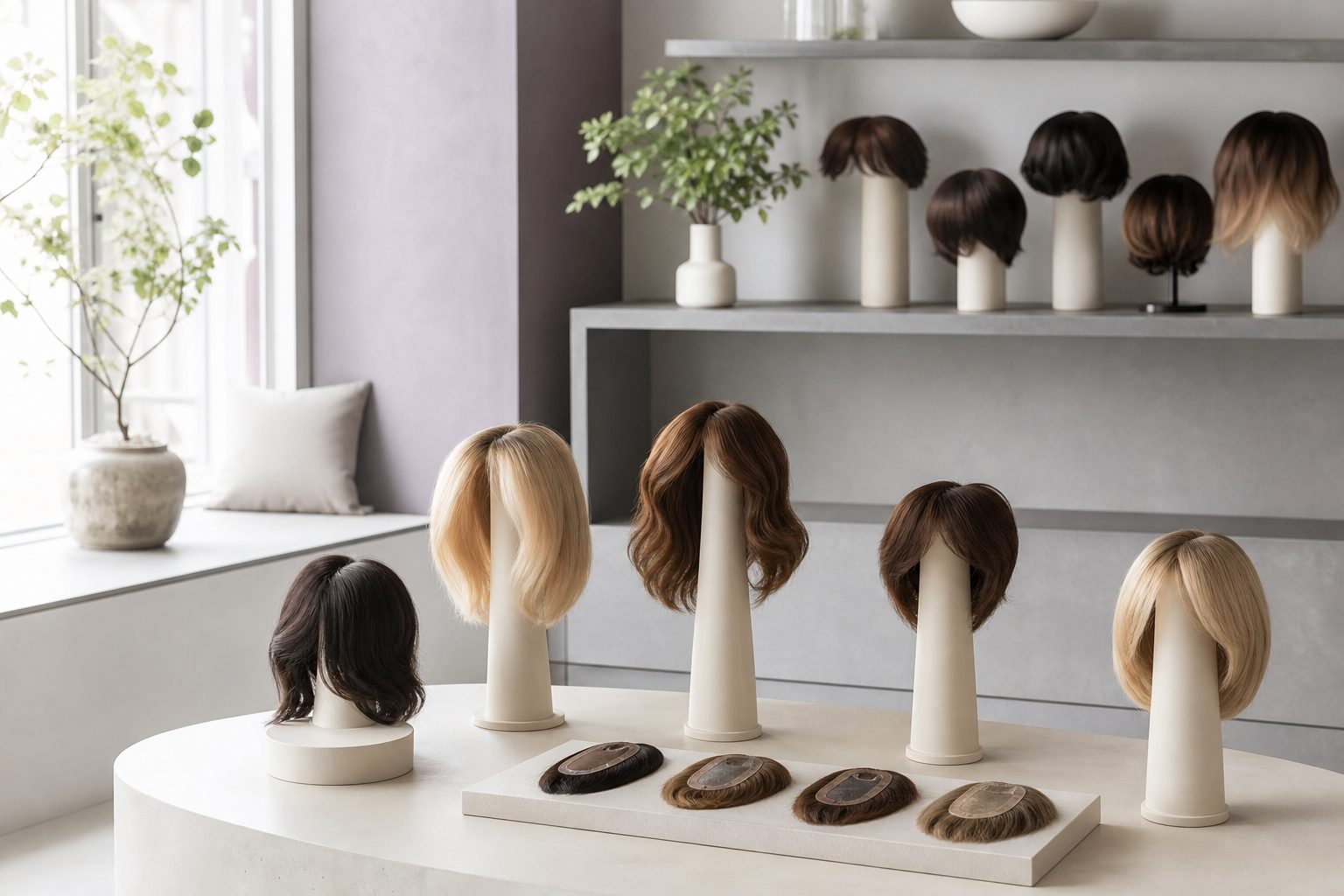
Yes, but not in the way most owners fear. Scalp cooling is not emptying fitting rooms. It is changing what walks through the door: fewer women who need full coverage from day one, more women who need something to fill in a thinning crown, and a meaningful number who start with cooling, lose more than they expected, and arrive mid treatment needing a unit fast.
The net effect on a studio that only stocks full wigs is a slow squeeze. The net effect on a studio that carries toppers, halos and partial pieces is closer to flat, with a different mix and a shorter average ticket.
The practical question is not whether cooling reduces demand. It is whether your inventory and your pricing are built for the client it produces.
How scalp cooling works and which regimens it suits
Scalp cooling lowers the temperature of the scalp before, during and after an infusion. The cold constricts blood vessels in the scalp and slows the metabolic activity of the follicle, so less of the circulating drug reaches the hair follicle and the follicle that is reached is less active and less vulnerable.
Two delivery methods exist in US infusion centers. Machine based systems circulate coolant through a fitted cap connected to a unit at the chair, controlled by the center. Manual cold caps are frozen to a very low temperature in dry ice or a dedicated freezer and swapped by a caregiver every twenty to thirty minutes across the whole infusion, which is a demanding job for whoever is doing the swapping.
Cooling is used mainly with solid tumor regimens, most commonly in breast cancer. It is not appropriate for every patient or every drug, and blood cancers are generally not candidates. The oncologist decides. Your role is never to assess suitability.
Two things determine what you see in the chair: the drug class and the number of cycles. Anthracycline based regimens are harder on hair than taxane based ones, and more cycles means more cumulative loss even with cooling working as intended.
Keep reading: What actually happens when a first time alopecia areata client sits down in my chair?
What partial retention looks like in the chair
This is the part vendor brochures do not prepare you for. Retention is rarely even.
The most common pattern is diffuse thinning across the whole head with heavier loss at the crown and the parting, because that is where density loss shows first and where the cap fits least tightly. The nape and the area just above the ears often thin badly, because cap contact there is poor. Hairline retention is usually decent, which is why these clients are good candidates for pieces that rely on the client's own front hairline.
Texture changes too. Hair that regrows or survives under cooling is frequently finer, drier and more fragile, and it does not hold color or heat styling the way it did. A client who arrives expecting her old blowout is going to be disappointed by her own hair, not by your product.
Practically, this means your consultation starts with a density and scalp visibility assessment, not a cap measurement. Part the hair in four places: center crown, the client's natural part, the nape, and just above each ear. Where you can see scalp under normal room light, that is where coverage is needed.
Toppers, halos, and partial pieces as a growing category
The partial category has gone from an afterthought in many studios to a real line. The distinctions matter when you are advising.
| Piece | Attachment | Best for | Weak point |
|---|---|---|---|
| Topper (clip in base) | Pressure clips into existing hair | Crown and part thinning with enough perimeter hair to anchor | Clips need hair to grip; traction risk on fragile hair |
| Halo or wire piece | Adjustable wire sits under the crown hair | Adding length and body when density is fair | Does not cover a visible part or crown scalp |
| Integration piece | Open weft base, client's hair pulled through | Diffuse thinning with hair still present across the head | Fussy to apply; needs client dexterity |
| Silk or lace top topper | Clips plus optional tape | Realistic part line where the part is the problem | Higher cost per square inch of coverage |
Two fitting notes that save returns. First, base size is the decision, not hair length: measure the actual area of scalp visibility and add roughly an inch of margin, then choose the base that covers it. Second, color match on a topper is harder than on a wig, because it sits against surviving hair that a client will keep comparing it to. Match to the mid lengths, not the roots.
Keep reading: What does a first oncology wig fitting appointment actually need to cover from start to finish?
Clients who start with cooling and return mid treatment
Plan for this client, because she is now a standard part of the book and she arrives under pressure.
She has typically finished two or three cycles, has lost more than she can hide, and is often disappointed, because cooling was the thing she was doing to keep control. She may also have paid out of pocket for the caps. She wants something today and she has an infusion in four days.
What she needs from you is speed and no commentary on her decision to try cooling. A few operational adjustments help:
- Keep a small stock of ready to wear synthetic units in the three or four most common colors and a mid cap size, so someone can leave wearing something.
- Take a full measurement record even when she buys off the shelf, so the second, better unit can be ordered without a repeat appointment.
- Note the cooling history in her record. If she is still cooling, her scalp is sensitive and she may not tolerate adhesive or a tight band.
- Ask whether she has a prescription. If she came in through a cooling program she often does not, and getting one takes a call to the oncology office.
Pricing and stocking for shorter, lighter pieces
Here is where the mix shift shows up on the profit line, and it is worth doing the arithmetic on your own numbers. As an illustration only, using assumptions you should replace with yours:
- Assume a full human hair unit sells at $1,800 with a 50 percent margin, so $900 gross per sale.
- Assume a human hair topper sells at $750 with the same 50 percent margin, so $375 gross.
- Assume the topper fitting takes roughly the same chair time, since color matching to surviving hair is slower even though there is less to fit.
On those assumptions, replacing one full unit sale with one topper sale costs about $525 in gross margin for the same hours. Two things close that gap. Toppers get replaced more often, because they take daily clip stress and sit against friction, so the repeat cycle is shorter. And a topper client is a strong candidate for a second piece in a different length or a backup for wash days.
So price the service, not just the product. A separate cut and customization fee on a topper, charged whether the piece was bought from you or not, recovers chair time that a lower ticket does not cover. Many studios undercharge here out of habit.
See how StrandRestore handles this for wig and hair loss studios
Talking about scalp cooling without giving medical advice
You will be asked whether it works and whether she should do it. Answer neither question. You are not her clinician and an opinion here is a real liability.
What you can do is describe, factually, what you see in your own chair, and send her back to her team.
Phrases that stay in bounds:
- "Whether cooling is right for you depends on your specific regimen, and your oncologist is the one to ask."
- "I fit clients who have used it and clients who have not. Results vary a lot, and I cannot predict which you will be."
- "If you do cool, come see me anyway before treatment starts so I have your color and measurements on file. That costs you nothing and saves weeks if you need something later."
That last one is the single most valuable sentence in this whole shift. A pre treatment consultation record turns an uncertain outcome into a client you can serve either way.
Positioning the studio for both outcomes
Stop treating cooling as competition. The studio that positions itself as the place you go before treatment, regardless of what you decide about cooling, captures the whole population instead of half of it.
Concretely: offer a low cost or complimentary pre treatment record appointment. Take cap circumference and the standard measurement set, photograph the client's hair in daylight against a neutral wall, log color, texture and part placement, and note her regimen start date. Stock partials alongside wigs. Train staff to fit both. And make sure the oncology navigators know you serve cooling patients too, because they are recommending cooling and assuming those patients no longer need you.
The next step
All of this rests on one thing: a record you can pull up eight weeks later when a client calls in a hurry. StrandRestore keeps the fitting record, cap measurements, color and texture notes and every order in one client file, so a pre treatment consultation converts into a same week order without a second appointment. It also generates the cranial prosthesis letter and itemized receipt and tracks claim status, which matters just as much for a topper claim as for a full unit.